NEW STUDY: CONSUMERS MORE LIKELY TO PURCHASE FROM A BRAND WHOSE VIDEO AD APPEARS NEXT TO CONTENT THEY TRUST

From Twitter, MAGNA & IPG Media Lab, the study looks at the importance of context in advertising 


NEW YORK – December 9, 2020 – “The Influence of Context” – a new study unveiled by Twitter, MAGNA & IPG Media Lab today – measures how the context in which video ads are viewed affects how consumers perceive them and how they perform. The U.S. study looks at context through the lens of content adjacency – the type of content an ad appears next to – and video experience – the way an ad is consumed (i.e. in-feed, non-feed, etc.).

The study was set-up to test pre-roll video ads before various types of content across in-feed and non-feed environments. Content types included premium publisher content, user generated content (UGC) from established creators and UGC from everyday people. Participants were exposed to different combinations of content and ads across three different environments: in-feed on Twitter, non-feed on a video aggregator and non-feed on publisher sites.

Here are the key findings on how different content types and environments drove different results:

  • Content adjacency is a powerful driver for brand KPIs. The importance of the environment in which ads appear extends far beyond brand safety alone. Even within brand safe content, content adjacency proves key in driving traditional metrics, such as brand favorability and purchase intent. The study revealed that when pre-roll is placed beside content that is perceived as high quality and highly trustworthy, we see a +12% increase in purchase intent based on trust and a +9% increase in purchase intent based on quality.
  • There’s a halo of premium. Consumers have an overall more positive opinion of premium content compared to UGC. Brands whose ads appear in front of premium are rated as more favorable and interesting.
  • All UGC is not created equally. There are benefits to appearing next to UGC created by verified content creators such as the ad being perceived as more relevant and trustworthy to the consumer. However, there is a big difference between content created by established creators and the average user. UGC created by the average user can actually stifle ad impact compared to high production UGC.
  • The power of choice. In-feed and non-feed environments offer different consumer experiences and therefore, different brand benefits. People felt less forced to watch pre-roll ads that appeared in a feed versus pre-roll in a non-feed environment. Also, in-feed pre-roll ads feel more relevant and have a greater impact on brand favorability (+11% for in-feed and +5% for non-feed) and purchase intent (+10% for in-feed vs. +6% for non-feed) versus the control.


Stephanie Prager, Twitter’s Head of Global Business Partners, said, “As digital video ad spend continues to rise, leading to a projected cost of $24.9 Billion by 2025, it is crucial for marketers to understand how to enable deeper connections between people and the things that they love and care about. We hope this study shines a light on the areas of opportunity and the range of video ad experiences marketers can explore to build high impact, performance driving strategies.”

“People often don’t realize just how powerful context is in advertising effectiveness. It’s not just about the platform or device – it’s also about content adjacency”, said Kara Manatt, SVP, Intelligence Solutions at MAGNA. “The importance of the content extends well beyond brand safety alone.  Premium in particular can have a powerful brand favorability halo.”

Download the full report

Twitter, MAGNA and IPG Media Lab conducted the same study in the UK, which you can find here. Similar studies for Brazil and Saudi Arabia will launch in 2021.


About Twitter

Twitter, Inc. (NYSE: TWTR) is what’s happening in the world and what people are talking about right now. On Twitter, live comes to life as conversations unfold, showing you all sides of the story. From breaking news and entertainment to sports, politics and everyday interests, when things happen in the world, they happen first on Twitter. Twitter is available in more than 40 languages around the world. The service can be accessed at twitter.com, on a variety of mobile devices and via SMS. For more information, visit about.twitter.com or follow @twitter. For information on how to download the Twitter and Periscope apps, visit twitter.com/download and periscope.tv.


About MAGNA

MAGNA is the centralized IPG Mediabrands resource that provides strategic investment and media intelligence for agency teams and clients. We utilize our insights, forecasts and strategic relationships to provide clients with a competitive marketplace advantage.

MAGNA harnesses the aggregate power of all IPG media investments to develop go-to-market strategies, designing unique partnerships to drive maximum value for our clients. MAGNA has set the industry standard for more than 60 years by predicting the future of media value. We publish more than 40 annual reports on audience trends, media spend and market demand as well as ad effectiveness.

MAGNA infuses the organization with knowledge that empowers better decision-making. We are a team of experts across five key competencies who support IPG cross-functional teams through: Partnership, Enablement, Accountability and Connectivity. Follow us on Twitter @MAGNAGLOBAL.


About IPG Media Lab

Part of the Interpublic network, the IPG Media Lab identifies and researches innovations and trends that will change the media landscape and how brands engage with their audiences. Since 2006, the Lab has worked with our clients and with industry partners who can help them best adapt to disruptive change. Its expertise, resources and consulting services also help to inform the learnings, strategies and business outcomes of all Interpublic agencies. For more information, please visit www.ipglab.com or follow @ipglab.


# # #


Media Contact:

Zinnia Gill

Mediabrands

Director, Global Corporate Communications

(646) 965-4271

[email protected]

NEW STUDY (UK): CONSUMERS MORE LIKELY TO PURCHASE FROM A BRAND WHOSE VIDEO AD APPEARS NEXT TO CONTENT THEY TRUST

From Twitter, MAGNA & IPG Media Lab, the study looks at the importance of context in advertising


LONDON – December 9, 2020 – “The Influence of Context” – a new study unveiled by Twitter, MAGNA & IPG Media Lab today – measures how the context in which video ads are viewed affects how consumers perceive them and how they perform. The U.K study looks at context through the lens of content adjacency – the type of content an ad appears next to – and video experience – the way an ad is consumed (i.e. in-feed, non-feed, etc.).

The study was set-up to test pre-roll video ads before various types of content across in-feed and non-feed environments. Content types included premium publisher content, user generated content (UGC) from established creators and UGC from everyday people. Participants were exposed to different combinations of content and ads across three different environments: in-feed on Twitter, non-feed on a video aggregator and non-feed on publisher sites.

Here are the key findings on how different content types and environments drove different results:

  • Content adjacency is a powerful driver for brand KPIs. The importance of the environment in which ads appear extends far beyond brand safety alone. Even within brand safe content, content adjacency proves key in driving traditional metrics, such as brand favorability and purchase intent. The study revealed that when pre-roll is placed beside content that is perceived as high quality and highly trustworthy, we see a +15% increase in purchase intent based on trust and a +8% increase in purchase intent based on quality.
  • There’s a halo of premium. Consumers have an overall more positive opinion of premium content compared to UGC. Brands whose ads appear in front of premium benefit from higher research intent and purchase intent.
  • All UGC is not created equally. There are benefits to appearing next to UGC created by verified content creators such as the brand being perceived as more innovative; and more preferred by the consumer. However, there is a big difference between content created by established creators and the average user. UGC created by the average user can actually stifle ad impact compared to high production UGC.
  • The power of choice. In-feed and non-feed environments offer different consumer experiences and therefore, different brand benefits. People felt less forced to watch pre-roll ads that appeared in a feed versus pre-roll in a non-feed environment. Also, in-feed pre-roll ads feel more relevant and have a greater impact on brand favorability (+6% for in-feed and +3% for non-feed) and purchase intent (+7% for in-feed vs. +3% for non-feed) versus the control.


Stephanie Prager, Twitter’s Head of Global Business Partners, said, “As digital video ad spend continues to rise, leading to a projected cost of $24.9 Billion by 2025, it is crucial for marketers to understand how to enable deeper connections between people and the things that they love and care about. We hope this study shines a light on the areas of opportunity and the range of video ad experiences marketers can explore to build high impact, performance driving strategies.”

Richard Oliver, Managing Director, MAGNA UK & Ireland said, “As the growth in the volume and diversity of video content continues, it’s increasingly difficult for advertisers to understand which of the many options are the most valuable. This important study reinforces the point that marketers have always known to be true – context matters – and helps advertisers make more informed choices in today’s video landscape.”

Harrison Boys, Director, Standards & Investment Product, MAGNA EMEA added, “Content is powerful when it comes to advertising strategies, and this study highlights that the context in which that content is delivered can be extremely impactful for brands, and not just an issue of brand safety.”

Download the full report


About Twitter

Twitter, Inc. (NYSE: TWTR) is what’s happening in the world and what people are talking about right now. On Twitter, live comes to life as conversations unfold, showing you all sides of the story. From breaking news and entertainment to sports, politics and everyday interests, when things happen in the world, they happen first on Twitter. Twitter is available in more than 40 languages around the world. The service can be accessed at twitter.com, on a variety of mobile devices and via SMS. For more information, visit about.twitter.com or follow @twitter. For information on how to download the Twitter and Periscope apps, visit twitter.com/download and periscope.tv.


About MAGNA

MAGNA is the centralized IPG Mediabrands resource that provides strategic investment and media intelligence for agency teams and clients. We utilize our insights, forecasts and strategic relationships to provide clients with a competitive marketplace advantage.

MAGNA harnesses the aggregate power of all IPG media investments to develop go-to-market strategies, designing unique partnerships to drive maximum value for our clients. MAGNA has set the industry standard for more than 60 years by predicting the future of media value. We publish more than 40 annual reports on audience trends, media spend and market demand as well as ad effectiveness.

MAGNA infuses the organization with knowledge that empowers better decision-making. We are a team of experts across five key competencies who support IPG cross-functional teams through: Partnership, Enablement, Accountability and Connectivity. Follow us on Twitter @MAGNAGLOBAL.


About IPG Media Lab

Part of the Interpublic network, the IPG Media Lab identifies and researches innovations and trends that will change the media landscape and how brands engage with their audiences. Since 2006, the Lab has worked with our clients and with industry partners who can help them best adapt to disruptive change. Its expertise, resources and consulting services also help to inform the learnings, strategies and business outcomes of all Interpublic agencies. For more information, please visit www.ipglab.com or follow @ipglab.


# # #


Media Contact:

Nicky Higgs

Mediabrands

Senior Comms Manager

[email protected]


PERSONALIZATION IS KEY FOR MARKETERS TO DRIVE CONSUMER CONNECTIONS: STUDY

By Jeanine Poggi. Published by Ad Age on 13 October 2020.

Brands should think more about personalizing ads based on major life events in an effort to drive better consumer connections, according to a new study from Magna and IPG Media Lab.

Personalized brand messages are increasingly important for marketers trying to reach consumers in a cluttered landscape, and those that are based on major life events strike an emotional chord with people. Those who saw an ad with these types of personalized messages were 16% more likely to want to hear more from a brand and 12% more likely to purchase the brands when compared to the same video ad without a personalized message, according to the study.

Similarly, personalizing ads based on search terms drove an 8% preference for the advertised brand over competitors.

The same pre-roll video ad can drive a 5% higher purchase intent when it is used with more relevant and personalized messaging, according to the study.

The study included responses from over 6,600 participants from the auto, retail and finance industries. Testing was conducted using each brand’s demographic target, as well as high-value audiences, which use people-based IDs for brand-identified targeting personas created by Kinesso.

“Relevance is a critical part of brand marketing strategy because people today are inundated with content on a daily basis and it can be overwhelming,” said Kara Manatt, senior VP, group director, Intelligence Solutions at Magna Global, in a statement. “Personalized messaging can not only help create more relevant ads, but also help amplify brand stories, forging stronger, more solid personal connections.”

While utilizing precision targeting of high-value audiences is effective, these consumers are typically critical of mass-market messages, and are much more open to personalized ads.

Of course, personalization doesn’t guarantee branding. The performance of a personalized ad is amplified when branding is incorporated into the messaging, making them 8% more memorable than standard ads. The same best creative practices should be applied when planning for personalization.

Read the article on Ad Age
Read the Press Release
Download the full study

NEW STUDY FROM MAGNA AND IPG MEDIA LAB REVEALS AD PERSONALIZATION OFFERS A KEY TO FORMING STRONGER PERSONAL CONNECTIONS

“Pursuit of Relevance” Finds Higher Levels of Personalization May Be Needed to Drive More Difficult-To-Shift Metrics


NEW YORK – October 13, 2020 – As the world has continued to innovate, we have found that ad personalization is one of the more effective tools out there to help brands deliver more relevant ad experiences. In a new robust study by MAGNA and IPG Media Lab, “Pursuit of Relevance: All About Ad Personalization,” the effectiveness of personalized ads on brand KPIs was quantified and revealed brands can forge stronger connections with people through relevance in the form of personalized messaging. Ultimately, the same pre-roll video ad can drive +5% higher purchase intent with the use of more relevant, personalized messaging.

The study found that most forms of ad personalization had value, but generally higher levels of personalization were often needed to shift more difficult-to-move metrics. For example, personalizing ads based on major life events struck an emotional chord with people, leaving them interested in hearing more from the brand (+16%) and more likely to purchase the brand (+12%) compared to the same video ad without a personalized message. Similarly, personalizing ads based on search terms, which are also deemed more sensitive than other forms of data such as age, drove brand preference (+8%).

The scope of the research included responses from over 6,600 participants and spanned three industry verticals (auto, retailer and finance). Testing was conducted among two audience types – each brand’s demographic target and High Value Audiences (HVAs), which are based on people-based IDs for brand-identified targeting personas created by Kinesso. Ultimately, six types of data sources for personalization were tested: demos, past purchases, location, life events, search terms, and persona-based messages (HVAs only).

“This is an important study that reinforces our belief that personalized messaging, when coupled with precision targeting is a key to driving the results that brands demand today of their advertising,” said Brendan Gaul, Global Chief Content Officer, Head of UM Studios. It also uncovers the importance of maintaining best practices and creative excellence in the development of the work. A good ad that is personalized works very hard. A bad ad that is personalized is still a bad ad.”

“Relevance is a critical part of brand marketing strategy because people today are inundated with content on a daily basis and it can be overwhelming,” said Kara Manatt, SVP, Group Director, Intelligence Solutions at MAGNA Global. “Personalized messaging can not only help create more relevant ads, but also help amplify brand stories, forging stronger more solid personal connections.”


Additional key findings the study found on the effectiveness of personalized messaging include:

  • Personalization doesn’t guarantee branding. Performance of personalized ads is amplified when branding is incorporated into the messaging. With branding in the message, personalized ads are +8% more memorable than standards ads. Creative best practices still apply, so the process of planning for personalization shouldn’t distract from the need to have strong branding.
  • Higher levels of personalization may be needed for more difficult-to-shift metrics. Personalizing ads based on life events and search terms were more likely to shift metrics such as brand preference and purchase intent. People were particularly open to the information in ads that were personalized based on their search terms and drove preference for the advertised brand over competitors (+8%). Ads personalized based on life events struck an emotional chord and drove intent to purchase (+12%).
  • Couple personalization with precision targeting. Using people-based IDs for targeting HVAs is effective, but these audiences are often critical of mass market messaging. In response to personalized ads, however, HVAs are much more open (+5%, “something I’m open to right now”). Brands should also consider crafting persona-based messaging for even greater impact (+20% on brand preference vs. +8% with standard personalization).


Download the full report


This study comes on the heels of another study MAGNA and IPG Media Lab conducted with Verizon Media, “Know Everything About Me: The Consumer Take on Data + Ad Personalization,” which delved into the intricacies of ad personalization and data privacy.


About MAGNA

MAGNA is the centralized IPG Mediabrands resource that provides strategic investment and media intelligence for agency teams and clients. We utilize our insights, forecasts and strategic relationships to provide clients with a competitive marketplace advantage.

MAGNA harnesses the aggregate power of all IPG media investments to develop go-to-market strategies, designing unique partnerships to drive maximum value for our clients. MAGNA has set the industry standard for more than 60 years by predicting the future of media value. We publish more than 40 annual reports on audience trends, media spend and market demand as well as ad effectiveness.

MAGNA infuses the organization with knowledge that empowers better decision-making. We are a team of experts across five key competencies who support IPG cross-functional teams through: Partnership, Enablement, Accountability and Connectivity. Follow us on Twitter @MAGNAGLOBAL.


About IPG Media Lab

Part of the Interpublic network, the IPG Media Lab identifies and researches innovations and trends that will change the media landscape and how brands engage with their audiences. Since 2006, the Lab has worked with our clients and with industry partners who can help them best adapt to disruptive change. Its expertise, resources and consulting services also help to inform the learnings, strategies and business outcomes of all Interpublic agencies. For more information, please visit www.ipglab.com or follow @ipglab.


Media Contact:

Zinnia Gill

Mediabrands

Director, Global Corporate Communications

(646) 965-4271
[email protected]


Video Ads and Brand Experiences Work Better Together in Streaming

By Mónica Marie Zorilla. Published by Adweek on 10 September 2020.

Giveaways and recommendations help drive brand awareness

While live events and sports remain uncertain, brands can step in to aid content discovery on streaming platforms. Magna, IPGLab, Roku

Connected TV usage among consumers has been sky-high through the Covid-19 pandemic, but many viewers are still struggling to find what to stream. That dilemma can become a brand marketer’s goldmine if they prioritize brand experiences that encourage content discovery, according to new research.

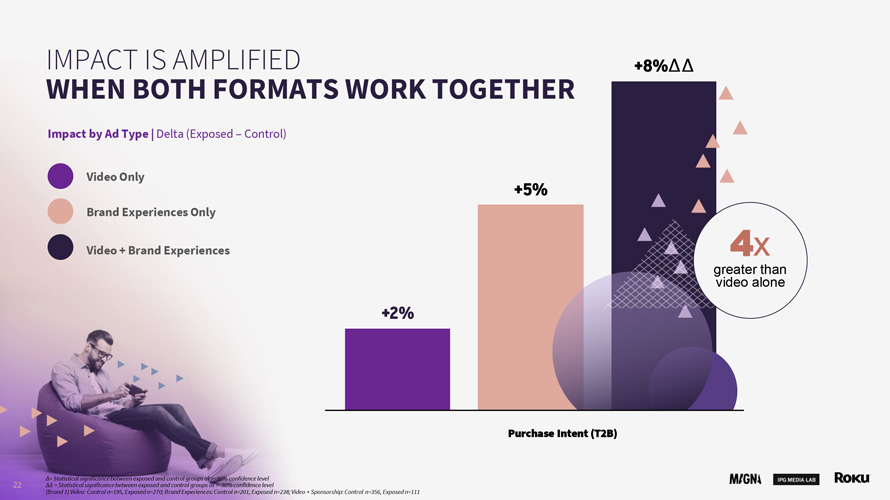
The study, from Magna and IPG Media Lab and commissioned by Roku, found that video advertising and brand experiences that offer free streaming choices, like promo codes and free movies, together generate four times greater purchase intent than video advertising alone.

Purchase intent can be particularly valuable for marketers who are considering leveraging brand experiences that aid in TV streaming content discovery—especially as sponsorships for live events and sports remain limited, said Dan Robbins, vp of ad marketing and partner solutions at Roku.

“A key question for CMOs and marketers is how to go big with the $12 billion spent on TV sports advertising,” Robbins told Adweek. “Brands can differentiate themselves by stepping in to aid content discovery and drive value as streaming surges.”


The study, over two phases in late 2019 and May 2020, relied on 2,300 respondents who were asked about brand experiences (and how they compare to other ads), how consumers felt about ads that helped them with content discovery while browsing streaming apps, and what advertisers could do to make brand experiences more effective.

A major challenge for many viewers was content discovery: 54% of those surveyed had no idea what to stream.

Nearly one-third of consumers surveyed said brand experiences that offer value—like free programming—are more fun than traditional ads, and one-quarter said those brand experiences don’t feel like a typical ad. However, only 6% said brand experiences were less intrusive than most ads.

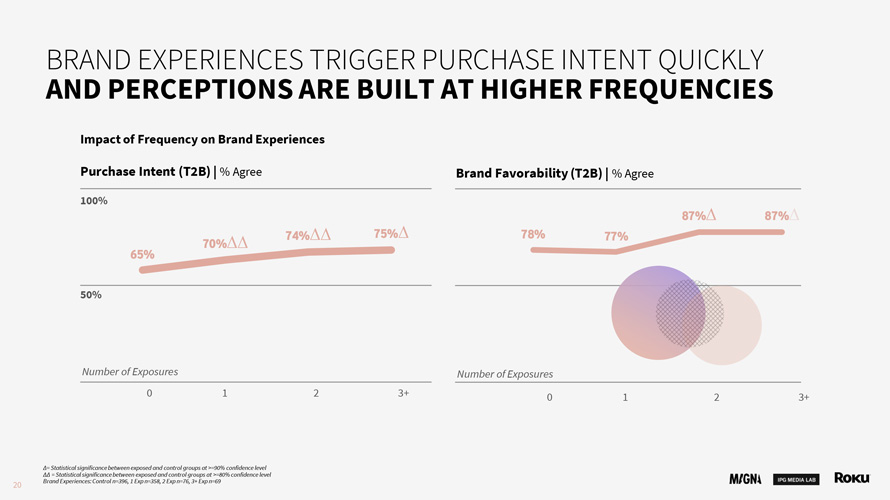
Among respondents who had interacted with brand experiences, 48% said they were more appreciative of brands that serve experiences, and 33% are more likely to consider buying the advertised products. Streamers with more frequency on branded experiences reported higher purchase intent (75%) and brand favorability (87%)—which researchers said indicates that consumer satisfaction with brand experiences drive positive opinions and build brand equity.


The study also found that both video advertising and brand experiences have an immediate impact on awareness, noticeability and memorability. However, both types of ads are persuasive in different ways: Video ads more often led to improved opinions on brands, while brand experiences were more likely to trigger purchase intent and favorability.

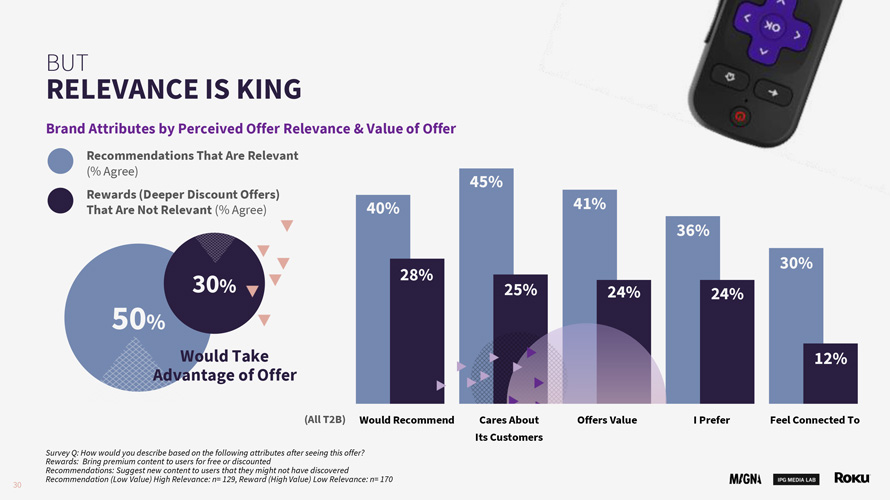
Relevancy, though, remained key. Nearly two-thirds of respondents surveyed in May were more likely to take advantage of a brand experience when the offer was relevant, whereas only 23% were likely to take advantage if the offer was not relevant. The study found that 50% of respondents would rather take advantage of a brand experience that was relevant but only offered recommendations on what to watch, compared to 30% of respondents who would rather take advantage of a brand experience that was irrelevant but offered premium content for a bargain price.


“In the end, relevance is king,” said Kara Manatt, svp and group director of intelligence solutions at Magna. “We found that it was more critical for a brand to deliver a content offer that consumers deemed relevant than to deliver a deeper discount offer that the consumer found irrelevant.”

Relevancy also affected consumers’ favorability of brands. Consumers were 31% more likely to think a brand cares more about its customers when the offer was relevant to them (compared to 18% when the offer was not relevant), and consumers are 30% more likely to find a brand more engaging if the offer is relevant (compared to 22% when it was not).

“Based on previous studies, we know that consumers tend to respond more favorably to personalized ads that cater to their interests,” said Chad Stoller, evp and managing partner of IPG Media Lab and global chief innovation officer at UM. “Offering up curated brand experiences alongside content discovery is a huge opportunity for brands looking to reach new audiences and convert them to longtime customers.”

Read the article on Adweek
Download the Report