MAGNA COLLABORATES WITH LINKEDIN TO EXPLORE CTV AD EFFECTIVENESS FOR B2B

Research finds 98% of LinkedIn users watch Connected TV, redefining advertising opportunities for business decision makers

October 29, 2024 — New York, NY —MAGNA Media Trials collaborates with LinkedIn to explore Connected TV (CTV) ad effectiveness in reaching B2B audiences. The new study – “Catching the Professional Eye: How B2B Marketers can Reach Decision Makers with CTV” — uncovered that 98% of LinkedIn users, of which 59% were sole decision makers, watch Connected TV weekly, signaling that it’s an effective way to reach B2B professionals. The study illustrates that going beyond traditional business channels such as broadcast cable/satellite, blogs or news websites, and podcasts could expand the marketing mix and reach new audiences for advertisers.

With video uploads growing 34% year-over-year on LinkedIn, the research dives into how video solutions, including CTV, can reach and engage decision makers creatively. According to the findings business decision makers are well represented among CTV viewers and are also receptive to B2B advertising. An impressive 94% of these viewers opt-in to ad supported CTV. This data underscores CTV as a powerful medium that drives meaningful actions and accelerates the deal cycle for B2B brands by either starting a free trial (79%) or purchasing (83%) a product or solution.

“The widespread accessibility of Connected TV is transforming B2B advertising, especially for decision makers,” said Kara Manatt, EVP of Intelligence Solutions, MAGNA. “This shift creates new opportunities for broadening audience reach and delivering even more innovative marketing strategies.”

Key Report Insights:

  • Young Decision-Makers: Contrary to the belief that business decision makers skew older, the study reveals that the majority of CTV viewers in this demographic are now Millennials.
  • Ad Readiness Across Genres: 94% of decision makers watch CTV with ads, including during comedy and drama programming, which were traditionally considered less receptive environments for B2B advertising.
  • Timing Matters: The best times to engage these decision makers are during early morning hours (52%) and in educational (69%) or news (66%) content when they are watching programs to stay informed.
  • Storytelling is Key: The research emphasizes the importance of incorporating a storytelling angle into CTV ads, suggesting that a narrative-driven approach resonates more effectively with this audience. Compared to average (100), ads that are funny (over-indexed at 131), emotionally appealing (over-indexed at 111), and feature relatable characters (over-indexed at 109) are highly preferred.

Catching the Professional Eye” is one of the first studies to deeply explore B2B engagement on CTV, and its unique insights can transform how marketers’ approach professional audiences.

To access the full report and learn more about leveraging CTV for B2B marketing, click here.

###


About MAGNA

MAGNA is the leading global media investment and intelligence company. Our trusted insights, proprietary trials offerings, industry-leading negotiation, and unparalleled consultative solutions deliver an actionable marketplace advantage for our clients and subscribers.

We are a team of experts driven by results, integrity, and inquisitiveness. We operate across five key competencies, supporting clients and cross-functional teams through partnership, education, accountability, connectivity, and enablement. For more information, please visit our website: https://magnaglobal.com and follow us on LinkedIn and Twitter.

Press Contacts

Jazmin Brooks
[email protected]
IPG Mediabrands / MAGNA

MAGNA and DeepIntent Reveal New Insights into How Pharma Advertising Influences Patient Behavior and Health Outcomes

91% of doctors say pharma advertising improves patient condition awareness and proactive health management

October 10, 2024 — New York, NY — MAGNA, the media intelligence and investment unit of IPG Mediabrands, today announced a new study in partnership with DeepIntent, the health advertising platform, that explores the impact of pharmaceutical advertising beyond its traditional role of promoting medications. The MAGNA Media Trials study – “Beyond the Prescription” – reveals how pharma ads influence patient behavior, improve health management, and offer untapped opportunities for brands.

The proprietary research surveyed over 1,100 patients and 1,000 doctors across various specializations to uncover the far-reaching effects of pharmaceutical messaging. Key findings demonstrate that pharma ads do more than just raise awareness of treatment options—they actively increase patient health intelligence, shape behavior, and improve health outcomes.

Key Insights from the Study Include:

  • Increased Awareness: 63% of patients reported learning about new medications through pharma ads, with this figure holding steady across generational lines, including 61% of Gen Z and 62% of Millennials.
  • Health Condition Discovery: 55% of respondents credited pharma ads with helping them discover new health conditions, with 62% stating they would have missed out on learning about a condition affecting them or someone close if not for the ads.
  • Condition Management: 54% of patients said pharma ads have helped them better manage existing health conditions, and 61% noted their overall understanding of their condition would be less comprehensive without these ads.


Doctors surveyed overwhelmingly agree with these patient outcomes. Nearly all (92%) noted that pharma ads increase patient awareness of treatment options, with 91% affirming that these ads improve patient understanding of their condition and encourage more proactive health management.

“This research shows that pharma ads truly have the potential to be much more than promotional tools and can be pivotal in helping people manage their health and discover new conditions. It’s incredibly valuable to find data that supports that brands can utilize their ads to build trust and create a more significant impact on patient outcomes,” said Melissa Gordon-Ring, Global President at Mediabrands Health, the center of excellence driving industry impact and integrated, scalable solutions for clients in the healthcare space.

The study also highlights demographic variations, revealing that younger generations, multicultural audiences, and parents trust and benefit most from pharma ads. These groups are more likely to discover new health conditions or improve the management of existing ones through exposure to pharmaceutical messaging.

Opportunities for Brands
The report underscores the need for pharma companies to build greater trust with consumers, particularly by incorporating real patient stories and transparent, patient-centered messaging. Trust is a critical driver of ad receptivity, and those who trust pharma ads are more likely to benefit from them.

“Pharmaceutical advertising has the potential to transform patient experiences, yet many brands overlook the significance of developing messages that resonate across different demographics,” said John Mangano, Chief Commercial Officer at DeepIntent. “DeepIntent’s research confirms that by embracing a more nuanced understanding of patient needs, brands can unlock greater engagement and drive meaningful health outcomes. MAGNA’s “Beyond the Prescription” research presents a roadmap for brands to engage with diverse audiences more effectively, providing opportunities to enhance both brand loyalty and patient health outcomes through relevant, trustworthy advertising.”

Click here to view the full report.

###

About MAGNA
MAGNA is the leading global media investment and intelligence company. Our trusted insights, proprietary trials offerings, industry-leading negotiation, and unparalleled consultative solutions deliver an actionable marketplace advantage for our clients and subscribers.

We are a team of experts driven by results, integrity, and inquisitiveness. We operate across five key competencies, supporting clients and cross-functional teams through partnership, education, accountability, connectivity, and enablement. For more information, please visit our website: https://magnaglobal.com and follow us on LinkedIn and Twitter.

About DeepIntent
DeepIntent is the health advertising platform marketers trust to drive effective campaigns. Purpose-built for healthcare and privacy-safe, the DeepIntent platform unites media, identity, and clinical data to produce industry-defining health intelligence. Consistently proven to deliver real-world results based on real-time optimization, the DeepIntent platform powers more than 600 pharmaceutical brands and all the leading healthcare agencies to innovate, differentiate, and reach their audiences across all channels and devices. For more information, visit DeepIntent.com or find us on LinkedIn. 

Press Contacts
Jazmin Brooks
[email protected]
IPG Mediabrands / MAGNA

Chris Shattuck
[email protected]
404-502-6755
FINN Partners on behalf of DeepIntent


MAGNA Media Trials & Spotify Reveal Key Strategies for Effective Podcast Advertising

NEW YORK, OCTOBER 2, 2024 – In a world filled with distractions, podcast listeners continue to stand out for their unwavering passion and active engagement, which marketers can benefit from as well. Today, MAGNA, the media investment and intelligence unit of IPG Mediabrands, in collaboration with Spotify, the world’s most popular audio streaming platform, released a study on preferences and how podcast listeners consume content. The study, titled “How to be in Podcasts,” offers a playbook on how brands can maximize their impact in the podcast realm.

The MAGNA Media Trials study highlights that podcasts have highly engaged, lean-forward audiences, with 62% of listeners actively engaged with content and paying close attention and 66% express strong passion for their favorite podcasts – two significant factors marketers should leverage. Listening to a podcast is an immersive experience that captivates the listener’s attention through content and ads.

The study was conducted in the US using ‘test ads’ to analyze four strategies for ads: ad length, music, voiceover tone, and contextual alignment. The research findings show that all forementioned strategies play a part in how listeners react to podcast ads.

Here are the key findings of each strategy:

    • Contrary to expectations, longer ads create more memorable experiences for podcast audiences, with 30-second ads showing a +36 pts increase in memorability, especially among potential new customers.
    • Upbeat music in ads infuses excitement and energy, increasing purchase intent by +6 pts and brand trust by +7 pts.
    • In the absence of music, mellow voiceovers capture more attention, are easier to follow, and lead to higher ad recall (+31 pts) and purchase intent (+12 pts).
    • The alignment between the ad and podcast content has a profound influence on performance, with ads that complement the podcast content (+18ptst) resonating more with listeners and evoking excitement about the brand (+17 pts).


To read the full study by MAGNA Media Trials and Spotify, click here.

About MAGNA
MAGNA is the leading global media investment and intelligence company, and part of the IPG Mediabrands network. Our trusted insights, proprietary trials offerings, industry-leading negotiation and unparalleled consultative solutions deliver an actionable marketplace advantage for our clients and subscribers. We are a team of experts driven by results, integrity, and inquisitiveness. We operate across five key competencies, supporting clients and cross-functional teams through partnership, education, accountability, connectivity, and enablement. For more information, please visit our website: https://magnaglobal.com/and follow us on LinkedIn.

About Spotify
Spotify’s platform revolutionized music listening forever when we launched in 2008. Today, more listeners than ever can discover, manage and enjoy over 100 million tracks, more than 6 million podcasts titles, and 350,000 audiobooks a la carte on Spotify. We are the world’s most popular audio streaming subscription service with more than 626 million users, including 246 million subscribers across 184 markets.

Political and Olympic Advertising Boost a Strong US Ad Market Further

New York, NY – September 16, 2024 – MAGNA U.S. Advertising Forecast Fall Update

Key Findings

  • Non-cyclical advertising revenues grew by approx. +11% in the first and second quarter of 2024, in line with MAGNA’s expectations,
  • A stronger macro-economic outlook, the momentum of digital media and streaming TV, and the impact of cyclical events, lead MAGNA to raise its second-half ad spend forecast.
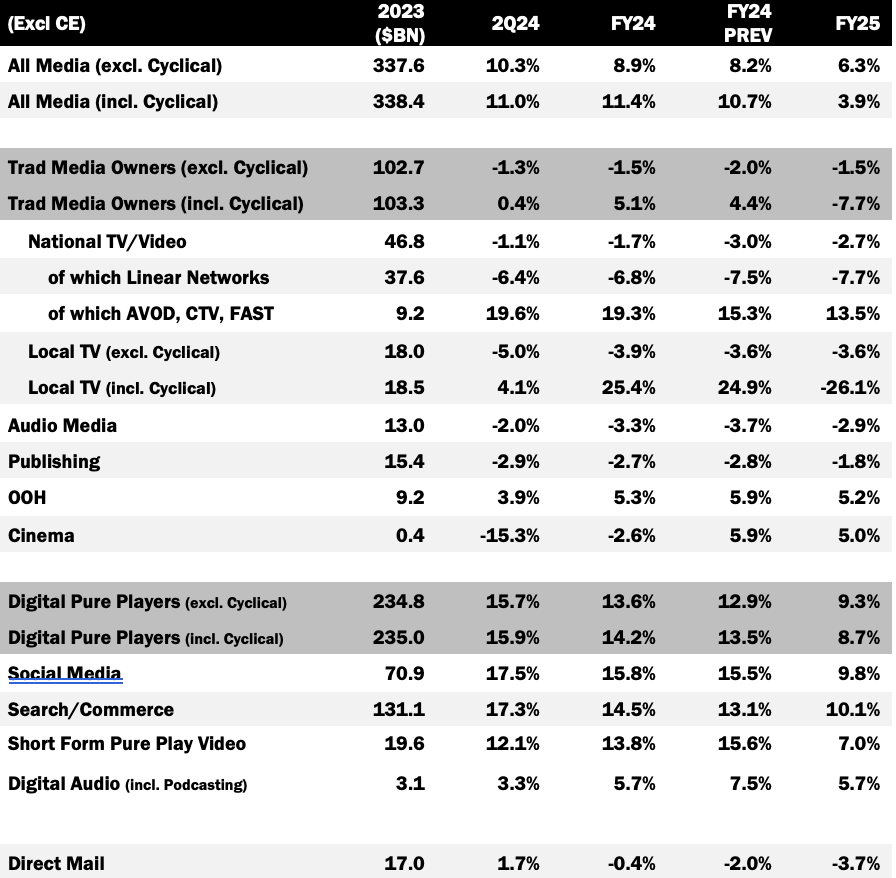
  • Full-Year non-cyclical ad spend will grow by +8.9% (previously: +8.2%), one of the best performances in twenty years.
  • Adding an expected $10 billion in incremental ad revenues due to cyclical events (presidential cycle and summer Olympics) total media owners ad revenues will increase by +11.4% to reach $377 billion this year (MAGNA’s previous forecast: +10.7% in June 2024).
  • Digital Pure Players (search, retail, social, and short-form video) capture most of the market growth, with non-cyclical advertising sales to grow by +13.6% to $264 billion (a 72% market share).
  • The ad revenues of Traditional Media Owners (cross-platform long-form video, audio, publishing, and out-of-home) will grow by +5.1% to $111bn as the influx of cyclical dollars in TV will more than offset a -1.5% decline in non-cyclical ad sales.
  • Ad-funded streaming TV is the fastest growing ad channel this year, with ad spend growing by nearly +20% so far, stabilizing cross-platform TV/video ad revenues.

Vincent Létang, EVP Global Market Intelligence and author of the report, said: “Even without the incremental advertising spending generated around cyclical events, 2024 already looks like a strong year for the US ad market, growing by almost +9%. This is due to strong demand from brands, in a stable economy, and supply-side innovations – e.g., the rise of ad-funded streaming and retail media – offering more scale and return-on-investment to marketers. On top of that, the additional advertising demand generated around Paris Olympics and a re-invigorated presidential campaign will add a record $10 billion of “cyclical” ad sales to bring total media owners ad revenues to an all-time-high of $377 billion.”

AI Tools Help Drive +11% Ad Spend Growth in First Half

Based on MAGNA’s analysis of media companies’ financial reports, total US ad revenues grew by +11.0% year-over-year in the second quarter. That was in line with first quarter, and in line with – slightly stronger – than MAGNA’s projection (+10.4%).

Digital pure players ad sales, rose by approx. +16% YOY, as both Meta and Google credited new AI tools – optimizing content creation or insertion – as driving incremental spending from brands. The Big Three (Meta, Google, Amazon) reported YOY ad sales growth rates ranging +15% to +18% for the quarter. Growth rates slow slightly compared to a peak in 1Q, as anticipated. Media owners provided confident growth guidance for 3Q despite year-over-year comps getting tougher in the second half.

Meanwhile Traditional Media Owners’ sales, excl. cyclical, reached $25 billion in the quarter (-1.3% year-over-year). National video ad sales (on linear TV and long-form streaming) were nearly stable (-1.1% to $11bn), the best performance in two years, as strong growth in ad-funded streaming (nearly +20% driven by the introduction of ads on Prime Video since January) nearly offset the long-term erosion of linear ad sales (-6.4%). Performance among the remaining TMO channels was mixed. Audio ad sales were flat (+0.4% YOY), as digital sales of +6.9% were able to offset broadcast declines of -3.5%. Podcasts were in the high-single-digit- range, and we expect them to remain there for the rest of 2024. Out of home ad revenues were solid at +3.9%. National ad sales continue to lag, while local ad sales are more dynamic. A bright spot this quarter was Direct Mail with a third straight quarter of growth for non-cyclical ad sales (+1.7%). This extends to political ad sales, that nearly doubled in 2Q24 compared to 2020.

In a positive economic environment, several industry verticals showed double digit increases in total advertising spending in the first half including Finance/Insurance (all-media growth +24% YOY) and Automotive (+22%). Technology brands increased ad spend, by +8%, for the first time in years. AI-powered products and services (e.g., Google’s Gemini, Microsoft’s Copilot) may contribute to boosting ad spend as several big tech players seek to dominate a very competitive AI space. Lagging so far this year: Travel (plateauing this year after showing huge growth post COVID) and Pharma (+1% overall but +6% in national TV). Finally, the Olympics boost CPG verticals (esp. drinks and personal care) and again Tech in the third quarter.

Full Year 2024: Strongest Growth in Twenty Years

Economists still expect a solid economy in coming months: full-year real GDP growth will reach +2.6%, inflation will slow down to 2.8%, and unemployment will remain under around 4%. The good macro-economic indicators have not fully translated into increased consumer confidence, however. The Michigan University index stood at 68 in August, which is still below the pre-pandemic average of 85 possibly because of high interest rates and election anxiety. Retail sales have improved lately (+3% YOY in recent months) but brick-and-mortar chains are struggling, while car sales are stagnating, as expected after strong growth in 2023.

With non-cyclical advertising sales already growing by +10.6% in the first half of 2024 (1Q: +10.8%, 2Q: +10.3%), the current attractiveness of the media offering, robust demand from CPG advertisers, and a solid macro-economic outlook, MAGNA is increasing its forecast for second half, non-cyclical ad spend growth to +7.4% (previously: +6.4%). The half-year YOY growth rate was always expected to slow down in the second half of 2024 due to very imbalanced comps in 2023 (weak first half, strong second half).

For the full-year 2024 MAGNA is now expecting advertising revenues to grow by +11.4% to $377bn (+8.9% excluding cyclical). +8.9% would be the strongest non-cyclical growth rate in more than twenty years, if excluding the post-COVID recovery in 2021. To find faster growth we need to look all the way back to the year 2000, when the US ad market rose by +10.8%. This performance is a result of double-digit growth for Digital Pure Players while Traditional Media Owners manage to stabilize ad sales, compared to a mid-single-digit rate of decline in recent years. DPP growth is driven by an acceleration in retail media spending, reallocating marketing budgets and growing the advertising pie, while TMO growth is driven by innovation (e.g., the rapid growth of ad-funding streaming).

Digital Pure Players’ full-year advertising sales will grow by +13.6% to $264 billion (a 72% market share) while the advertising revenues of traditional media owners will grow by +5.1% (as the record influx of cyclical ad dollars offsets a -1.5% decline in non-cyclical ad sales).

Within digital pure players, Search/commerce sales will rise +14.5% to $150bn. Retail media networks will see growth of +20% and near the $50bn ($46bn), which we expect them to surpass next year, while core search (i.e., keyword search) will gain +12% in 2024. Social media sales will rise +15.8% to $82bn, thanks in large part to the AI tools that we mentioned earlier.

Within traditional media owners, non-cyclical national television sales ad will drop on “only” -1.7% to $46bn. Linear ad sales (broadcast and cable networks will fall -6.8% while streaming video sales will grow +19.3% to $11bn and account for nearly 25% of the total market.

Non-political local TV sales will drop -3.9% to $17.3bn but total ad revenue will grow by +25% when including political ad sales. Audio ad sales will rise +1% to $16bn, as a +7% growth in audio streaming and podcasting will offset an erosion -3% in broadcast radio ad sales. Finally, OOH ad revenues will increase by +5.3% to $9.7bn, as we expect the second half ad sales to accelerate thanks to easier comparables.

Cyclical Events Bring in $10bn of Incremental Ad Sales in 2024

Three major cyclical events generate significant additional ad spend and incremental ad sales in 2024: the presidential election cycle, the Summer Olympics and – to a smaller degree – the Copa América soccer tournament, hosted by the US.

Political advertising is by far the largest cyclical booster on even years, and it’s expected to reach new heights this year. MAGNA is forecasting a +11% increase in political ad sales over the previous presidential cycle (2020) to generate a record $9 billion in incremental media owners’ revenues. MAGNA raises its political forecast as Democrat fundraising re-accelerated right after President Biden dropped out of the Presidential race and endorsed VP Kamala Harris. Donations have since flooded into the Harris/Waltz campaign, and total fundraising monitored by the FEC is once again above 2020 levels. A lot of ad spend will again concentrate in a small number of Swing States (Pennsylvania, Michigan, Wisconsin etc.), boosting the ad sales of local television stations and localized digital media. In these battleground states, the extra demand will temporarily squeeze supply and cause raising airtime costs for non-political advertisers.

The other major cyclical event this year was the Paris Olympic games. After the disappointing, COVID-hit Tokyo Games, Paris 2024 brought back the Olympic magic for athletes, fans, and advertisers, with total cross-platform audience delivery up +82% (TAD, source NBCU). For the 17 days of the event, Paris 24 boosted NBCU ratings by +300% vs the same period in 2023, but also brought up overall Primetime TV 18-49 ratings (all networks) by +4%, reversing a year-to-date trend of -14% on the same demographic. Peacock contributed to strong viewing numbers and approx. 13% of total Olympic viewing. With strong ratings freeing up additional ad inventory, NBCU’s total ad sales grew by an estimated +20% vs Tokyo to reach $1.5 billion, of which approx. $400 million generated around digital and streaming properties, and $1.1 billion for linear TV (broadcast and cable networks) (+6%). MAGNA believes that more than 60% of these ad sales will prove net incremental to full-year national TV ad revenues.

2025: Robust Economy and Ad Market, but no Cyclical Events

The advertising market will remain strong in 2025, with non-cyclical ad spend growing +6.3% to $391bn, as the market heads towards $400bn in 2026. However, given the lack of cyclical events in odd-numbered years, total ad sales (incl. cyclical) will rise only +3.9% above 2024. Digital pure players will again drive the market, growing +9.3% to $289bn, while traditional media owners will erode by -1.5% to $102bn. Search/commerce and social media will gain +10%, and the two channels will account for two thirds of all advertising in the country. Most other channels will not perform as well. National television sales will drop -2.7% while local television sales will underperform and decline -3.6%. OOH sales will rise +5.2%, but radio sales will drop -0.8% and publishing sales will decline -1.8%.

The next MAGNA ad forecast (US and Global) will be published early December.

Key Figures
ABOUT MAGNA

MAGNA is the leading global media investment and intelligence company, and part of the IPG Mediabrands network. Our trusted insights, proprietary trials offerings, industry-leading negotiation and unparalleled consultative solutions deliver an actionable marketplace advantage for our clients and subscribers. We are a team of experts driven by results, integrity, and inquisitiveness. We operate across five key competencies, supporting clients and cross-functional teams through partnership, education, accountability, connectivity, and enablement. For more information, please visit our website: https://magnaglobal.com/and follow us on LinkedIn.

ABOUT MAGNA MARKET INTELLIGENCE

MAGNA market intelligence is media centric. It estimates net media owners advertising revenues based on an analysis of financial reports and data from local trade organizations; other ad market studies are based on tracking ad insertions or consolidating agency billings. The MAGNA approach provides the most accurate and comprehensive picture of the market as it captures total net media owners’ ad revenues coming from national consumer brands’ spending as well as small, local, “direct” advertisers. Forecasts are based on economic outlook and market shares dynamic.

MAGNA has set the industry standard for more than 60 years by predicting the future of media value. We publish more than 50 reports per year on ad market trends and media behavior trends.

To access MAGNA reports, insights, and datasets, or to learn more about our market intelligence services, contact [email protected].

Watching together: how communities are united through live TV

Published on The Drum

One month on from Cannes and ahead of the Olympic Games Paris 2024, we recap what got leaders at Uber Advertising, State Farm, Bain, Magna, Fox and more, talking about the power of live TV on FreeWheel Beach.

From big games in sport to big names in entertainment, 2024 is live TV’s moment. The Super Bowl LVIII drew an estimated 123.4 million audience across TV and streaming – making it the most-watched live TV show in history, while the Grammy Awards attracted over 17 million viewers, with 173% more streams than last year.

While television has evolved over the past decade, one pattern remains the same: the appetite for live events. But when it’s only live once, milliseconds matter. How can advertisers make the most of this moment of emotional engagement?

In a new video series, #YOLO (You’re Only LIVE Once), we gathered key players from the buy- and sell-sides of the TV ecosystem, including Uber Advertising, State Farm, Bain, Magna and Fox, on the FreeWheel Beach in Cannes to get their take in the moment on the challenges and opportunities with live as TV consumption shifts from linear to streaming.

High attention, high precision
Technology and data advancements are changing the live TV industry – combining mass scale and moments of emotional engagement with the precision of addressable TV, giving advertisers of all sizes more opportunities to connect in the highest attention environment.

“Live TV can still be about big brand moments at mass scale – and that continues to have great value,” says Pooja Midha, general manager, Effectv. “But it can also now be about bringing precision into the equation through the advancement of our ability to apply data insights in that environment to reach an audience inside an incredibly emotional event.”

NBCUniversal and Comcast Advertising, for example, have created the opportunity for brands to be promoted alongside NBC’s coverage of Olympic Games Paris 2024 programmatically on Xfinity platforms – the first time brands can be featured throughout the user interfaces on Xfinity X1, Xfinity’s Xumo Stream Box, and Xfinity Flex.

“Advertising in live TV is changing dramatically because something new is happening; it’s addressability,” adds Philippe Boscher, head of digital marketing at TF1 Publicitéon. “Live addressable and linear addressable means that now you can combine the power of live TV with the capability to target niche targeting, geo localization data targeting.”

Social connections
Beyond the record viewership that live events draw, the enduring appeal of live TV is its ability to create communal experiences and deliver real-time content. A report from FreeWheel, It’s Only Live Once: How TV Advertisers Can Capture Audiences in the Moment, finds that live events are 17% more likely to be viewed by multiple people together versus other programs; 54% of sports viewers often watching live with others.

Research from Bain & Company also found that 51% of consumers who are streaming content are looking at social media at the same time. That’s why it’s important to think about “how to connect moments from what’s happening on the screen through live and connected TV into social interactions in the same moment,” says Jeff Katzin, partner, Bain & Company. “There’s an explosion in appetite for real and authentic experiences. Consumers are really looking for opportunities to have a shared moment or connect with others – and that’s something the power of live can do better or as well as anything that exists out there.”

The live experience doesn’t just happen on the big screen – but on the journey to the live event. “Consumers want to watch what they want to watch when they want to watch it,” says Megan Ramm, global director, head of CPG partnerships at Uber Advertising. “The on-demand nature of people’s desire for personalization and creating experiences that they want for viewing and the choices that they have is presenting unique opportunities to connect with them when they’re in a positive mindset, attentive and receptive to wanting to receive those messages.”

Interacting in the moment
While it’s clear that consumption habits are changing, the real benefit for brands is to reach new audiences and attract younger generations through alignment with live TV.

“Live programming is still very important to us, especially around sports; it’s where the eyeballs are, but it also gives us an opportunity to move at the pace of culture,” says Kristyn Cook, executive vice-president and chief agency, sales and marketing officer at State Farm. “We all recognize that consumption habits are changing – they want to consume content anywhere, anytime across any screen that they want, so it’s important to have a very cohesive, comprehensive approach to both live TV and streaming.”

But the fundamentals remain the same: to deliver the best viewing experience. “It’s a different relationship, different consumption that’s much more forward than laid back,” says Thomas Bremond, chief revenue officer, international, FreeWheel. “My kids don’t even know what changing the channel means, they don’t know the technical infrastructure, but they know that the experience has to be seamless and perfect.”

With this scale, the opportunities are for brands are endless – offering more interactivity than before. “The fact that live programming is living on these new platforms brings the opportunity for innovative ad units like interactive and shoppable, and first-party data to connect and target audiences in a different way to move down the funnel quicker,” says Dani Benowitz, US and global president at Magna.

“We talk to our clients a lot about the power of live and migrating dollars that may have been slated for general entertainment, to keep moving to sports and live events because of the watercooler moments and the leaned in engagement from consumers.”

Engineering challenges
As record amounts of viewers tune in to their favorite live events, advertisers have the opportunity and responsibility to provide an enjoyable viewing experience.

“At any one time a single piece of content, including live events, can be consumed on more than 400 different endpoints,” explains Mark McKee, general manager, FreeWheel. “It makes it very hard for programmers and very complex for buyers. Within live events, milliseconds matter and so having the most direct connection is the most powerful way in which to engage with a consumer.”

That’s why FreeWheel unveiled a new suite of live product capabilities in Cannes, to better enable programmatic transactions to take place across some of the largest live events on streaming platforms – include the Olympic Games Paris 2024.

“From a creative and production perspective, we look at all the different canvases that we distribute sports to – from connected TVs to broadcast to cable, through to mobile and web, and we think differently about those canvases and what we can do with them,” adds Paul Cheesbrough, chief executive officer of Tubi Media Group, a business of Fox Corporation. “Technically, it’s a very challenging thing to plan for [streaming major live events like the Super Bowl] and why we work with companies like FreeWheel to deliver very low latency, high-quality streams.”

The recent partnership between FreeWheel and Fox Corporation, for example, sees FreeWheel programmatically enable Tubi, and the entire One Fox portfolio, by serving the company’s primary monetization engine, and includes a proprietary integration with Fox’s AdRise to further drive scale, access and a more simplified path to premium video ad inventory.

As the industry continues to innovate, it’s clear that it’s live TV’s moment as a powerful medium for advertisers to connect with audiences in meaningful and memorable ways. Whether through sports, entertainment, or special events, its ability to bring people together and create shared experiences will ensure its relevance in the ever-evolving media landscape.

Watch the full video ‘#YOLO (You’re Only Live Once)’ for more insights.

Read the Article on The Drum