BREAKING NEWS: NEW RESEARCH STUDY BY MAGNA & DISNEY ADVERTISING SALES EXPLORES BRAND EFFECTIVENESS IN NEWS PROGRAMMING

Study Finds Brands Should Support Quality Journalism & Optimize Ad Strategies Across All News Genres

 
New York, NY – November 2, 2021 – Brand safety concerns have been widespread in the last few years, with many marketers becoming increasingly focused on ensuring safe and relevant environments for their advertising. A new study by MAGNA Media Trials, MAGNA’s industry-leading proprietary research offering, in collaboration with Disney Advertising Sales, “No News Is Bad News: Ads In News & Other Types of Content,” reveals that the news source a brand is featured in matters more than the surrounding content. The study also found that having a presence in reliable news sources drives better ad effectiveness. Additionally, a marketer’s ad strategy should be customized and tailored by news genre to deliver optimal ROI.

The mission of the study was to uncover the true impact of advertising within news and define guardrails for it as well. A key finding of the study is that ads in news work just as well as in non-news and even have a strong positive impact on brand favorability when the news itself is deemed “heavy” by viewers. The study also found that news content is so uniquely valued that brands running in news are perceived as trustworthy and providing more valuable information than when they appear in non-news content.

Detailed key findings of the study include:

  • News content is uniquely valued, and ads benefit from the positive halo: People found news content more valuable, trustworthy and interesting; and as a result, ads in news felt +8% more relevant, +6% more valuable, and +4% more trustworthy, compared to non-news content.
  • News perceived as ‘heavy’ isn’t bad for brands, instead it drives brand impact: Brand favorability was up +7% and intent to recommend advertised brand was up +5% from ads in news perceived as heavy by participants.
  • Credibility of the news source matters – especially to the affluent: 57% of respondents feel that brands should vet the news source before advertising. This was especially true for more affluent households, those with incomes $100K+ (61%), versus those with incomes of $35K or less (52%).
  • The news source a brand runs its ad on matters more than the news content itself: Ads on a high-quality, trusted and well-respected news source led to increased brand favorability (+21%), research intent (+25%), and purchase intent (+21%).
  • Ad message is key when advertising in different types of news: In hard news, a more direct, product focused ad message led to higher brand impact, with favorability up +10%, research intent up +5% and purchase intent up +7%. Conversely, in race and culture news, a storytelling approach worked better for elevating favorability (+11%) and purchase intent (+10%).

 
“An important insight from the study is how passionate people feel about the news source that a brand advertises on, and the reliability of that source is a key driver of purchase intent,” said Joshua Lowcock, Chief Digital Officer, UM, and Global Brand Safety Officer, IPG Mediabrands. “Brands should support quality journalism if they want to maximize the effectiveness of their ad spend. It recognizes that credible and trusted news websites are not a brand safety risk and that where you place your ad matters.”
 
“The diversified storytelling that news provides —from local community coverage, to pop culture, to international affairs— is where the opportunity lies. We’re proud to release this in-depth report, in collaboration with MAGNA, to demonstrate the impact of advertising within this format,” said Asaf Davidov, VP Measurement & Insights for Disney Advertising Sales. “These insights confirm that consumers associate ads seen in news with being trustworthy and valuable. Which offers brands the opportunity to tailor their message to the audience.”
 
The study recruited participants from a nationally representative panel, where they were randomized to a brand’s ad or a control ad. Participants watched a video or viewed an article of their choice on their assigned platform. Appropriate ads were served based on test or control groups. A post-exposure survey was conducted to measure impact on traditional branding metrics and to obtain qualitative feedback. The variables tested were across content genres, news genres, platforms, ad formats, brand verticals and creative strategies.
 

The full study can be found here.

 
About Disney Ad Sales:
Disney Ad Sales is responsible for advertising sales and integrated marketing for The Walt Disney Company’s entertainment and sports offerings through linear, digital, social, audio and ad-supported streaming businesses. This includes ABC, ABC News, Disney Channels Worldwide, Disney Digital, ESPN Networks, ESPN+, Freeform, FX, National Geographic, Hulu, and its eight ABC-owned local stations.

About MAGNA:
MAGNA is the leading global media investment and intelligence company. Our trusted insights, proprietary trials offerings, industry-leading negotiation and unparalleled consultative solutions deliver an actionable marketplace advantage for our clients and subscribers.

We are a team of experts driven by results, integrity and inquisitiveness. We operate across five key competencies, supporting clients and cross-functional teams through partnership, education, accountability, connectivity and enablement. For more information, please visit our website: https://magnaglobal.com/ and follow us on LinkedIn and Twitter.

Media Contact:
Zinnia Gill
Mediabrands
Director, Global Corporate Communications
(646) 965-4271
[email protected]
Advertising In Reliable News Sources Provides Stronger Brand Effectiveness

By Brad Adgate, Published by Forbes
 
In a polarizing political environment, news programming across numerous platforms continues to generate millions of viewers each day. In a political off-year, three 24-hour news networks remain the three highest rated cable networks on television. Nonetheless, at times, polarizing comments or questionable content from news providers has led marketers, concerned about brand safety, to pull their ads. Conversely, reliable news providers continue to be a safe harbor for advertisers with positive results.
 
A study from MAGNA Media Trials and Disney Advertising Sales released today called “No News Is Bad News: Ads in News & Other Types of Content,” finds advertising in a reliable news source creates stronger brand effectiveness. The study also found a tailored ad in the news genre can deliver an optimal ROI for marketers. Below are some other findings.
 
People found news content to be more valuable, trustworthy and interesting. Respondents said ads in news content were 8% more relevant, 6% more valuable and 4% more trustworthy when compared to non-news programming.
 
News that is considered to be depressing can still help to drive brand impact. The study found brand favorability grew by 7% with product recommendations increased by 5% from ads airing in a gloomy newscast.
 
The survey also highlighted the importance of credibility of news sources, especially with upscale audiences. A total of 57% of respondents said marketers should vet news sources before advertising. For upper income households ($100K+), 61% agreed with the importance of sources, compared to 52% for households with an income of $35K or less.
 
Ads on a trusted, well-respected and high-quality news source, help advertisers to bolster such lower funnel attributes as brand favorability (+21%), research intent (+25%) and purchase intent (+21%).
Respondents said ad messaging should vary depending on the type of news. For example, with “hard news” a more focused message will increase brand favorability by 10%, purchase intent by 7% and research intent by 5%. In contrast, race and culture news requires marketers to take a “storytelling” message which would increase favorability by 11% and purchase intent by 10%.
 
The survey concludes with the following implications:

  • Brands should support quality journalism, recognizing there is a difference between unsafe content and news on trusted websites.
  • Advertisers should identify and deliver media against reliable news sources to drive better effectiveness. The reliability of the source has more of an impact on ad effectiveness than the news content itself.
  • Optimize ad strategies that over index on your marketing goals, as the same ad performs differently across news genres

 
The survey was released at a time when social media has come under fire and government investigations for failing to restrict false news and misinformation. According to a recent Pew Research survey, 48% of U.S. adults get their news from social media “often” or “sometimes.”
 
Andrew Heyward, professor at ASU’s Walter Cronkite School of Journalism & Mass Communication and former President of CBS News says, ”This study is encouraging for both marketers and news organizations — and therefore for consumers. Marketers who advertise in news outlets benefit from a ‘halo effect’ that relies more on the credibility of the news source than the specific nature of the content, which means that high-quality, trustworthy, responsible news coverage is not just important for our democracy, but also good for the bottom line.”
 
In a statement about the survey, Joshua Lowcock, the Chief Digital Officer at UM Worldwide and Global Safety Officer at IPG Mediabrands says, “An important insight from the study is how passionate people feel about the news source that a brand advertises on, and the reliability of that source is a key driver of purchase intent.” Lowcock continues, “Brands should support quality journalism if they want to maximize the effectiveness of their ad spend. It recognizes that credible and trusted news websites are not a brand safety risk and that where you place your ad matters.”
 
Asaf Davidov, VP Measurement & Insights at Disney Advertising Sales, added, “The diversified storytelling that news provides —from local community coverage, to pop culture, to international affairs— is where the opportunity lies. These insights confirm that consumers associate ads seen in news with being trustworthy and valuable. Which offers brands the opportunity to tailor their message to the audience.”
 
A similar study with comparable results, was directed by media research leader Bill Harvey. Among the findings, Harvey notes, “In the largest multivariate study in history ($2.2 trillion in sales vs. $48 billion in ad spend), we found news and sports – the two main forms of live TV – have the highest return on ad spend (ROAS) of all linear television and digital genres, other than network TV digital which is even higher. A literature review suggests the main reason for the advertising impact of news is cognitive, that it is the media type eliciting the highest degree of focused watching and listening attention.”
 
With fundraising for the 2022 midterm elections soaring, it is projected there will be record year for political ad dollars rivalling the 2020 elections. Local broadcast news, especially in battleground states, is expected to be a primary beneficiary of the bounty with candidates expected to invest billions of ad dollars in messaging. The MAGNA/Disney survey found for political (and hard) news sources reliability is an important criterion.
 
The MAGNA/Disney study recruited participants from a nationally representative panel, where they were randomized to a brand’s ad or a control ad. Participants watched a video or viewed an article of their choice on their assigned platform. Appropriate ads were served based on test or control groups. A post-exposure survey was conducted to measure impact on traditional branding metrics and to obtain qualitative feedback. The variables tested were across content genres, news genres, platforms, ad formats, brand verticals and creative strategies.
 

Read the article in Forbes


Download the full study

What does ASMR and Mukbang have to do with advertisers?

By Patti Summerfield, Published by CARD Online
 

While brands go to great lengths to avoid offensive content, MAGNA suggests thinking twice about ad placement beside videos that don’t align with their values.

 
For years, advertisers have focused on avoiding having their ads appear next to offensive content. However, the negative effects of proximity to content that might clash with a brand’s values has, interestingly, not received as much attention.
 
“The industry is clear on the fact that brand safety is important. No brand wants to be next to offensive content, but we don’t have a lot of answers on what happens with content in the grey area – content that may be okay for some brands but not all,” says Kara Manatt, SVP, group director, Intelligence Solutions at MAGNA. “We did this research to quantify the effects on advertising when content is misaligned with a particular brand’s values.”
 
In partnership with Channel Factory, MAGNA (the intelligence arm of Mediabrands) has produced a study – The Proximity Effect – that shows ad effectiveness is only as good as the content it is running in, and misaligned content erodes the impact of hardworking ads. It also looks at the safeguards that brands can put in place to ensure they are not running next to content that is misaligned with the brand.
 
Some of the tested content included that which “commonly produces visceral reactions in people, including skin conditions (e.g. pimple popping), ASMR (videos inducing autonomous sensory meridian response) and Mukbang (video host consumes various quantities of food),” stated MAGNA.
 
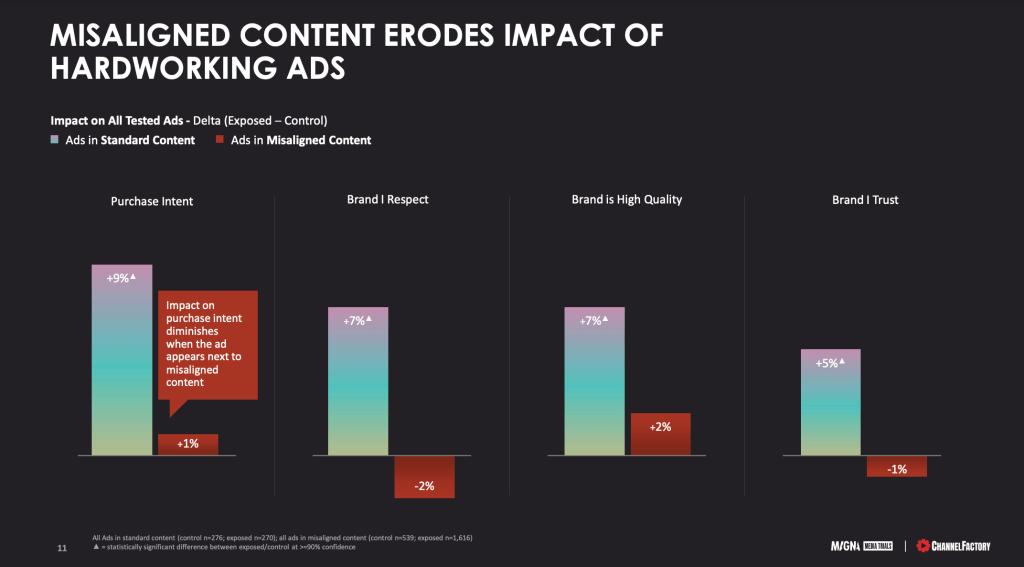
While people don’t forget ads that are placed next to or within misaligned content, they do tend to be remembered for the wrong reasons. The study found that brands in misaligned content left consumers with a bad memory attached to the brand and found the content association to be weird or low calibre for the brand. As a result, there was a loss of impact on purchase intent (-8%), brand respect (-9%), impressions that the brand is high quality (-5%), as well as brand trust (-6%).
 
On the flip side, when ads in standard content were tested, purchase intent increased 9%, brand respect rose 7%, impressions that a brand is high quality went up 7%, and brand trust got a 5% boost.
 
Manatt says brands need to be just as careful of misaligned content as they do traditionally unsafe content. “For example, many brands want to appear next to trending content, but sometimes what’s trending could be misaligned with brand values and could hurt the performance of ads. We learned that sometimes even the most popular, entertaining content can be the most damaging for brands.”
 
The Proximity Effect also found that brands are held most accountable for the content they appear next to in a pre-roll environment. Consumers were 1.5 times as likely to feel the brand endorsed the misaligned content after watching a pre-roll video compared to the video card environment – mobile environments where viewers swipe through cards, which are essentially full screen videos.
 
In a video card environment, the closer the ad, the stronger the brand association. Consumers were 10% more likely to believe the brand supported the misaligned content that the ad was immediately next to compared to two videos away.
 
Manatt adds, “To avoid diminishing the effectiveness of otherwise powerful ads, brands need to pay just as much attention to content misalignment as they do to unsafe content when it comes to ad placement.”
 

Read the article at Card Online


Download the Full Study

Ads near “misaligned content” can hurt purchase intent and brand trust: Magna study

By Chris Powell, Published by The Message
 
Ads that appears alongside “misaligned content,” a broad term that can include everything from pimple popping to ASMR videos, can see effectiveness reduced and leave consumers with a negative impression of a brand, according to a new research study from Magna and Channel Factory.
 
While brands are focused on safeguarding against appearing alongside unsafe or harmful content,The Proximity Effect: Quantifying the Impact of Misaligned Content in the Wild West of Video, says that running alongside safe but otherwise misaligned content can have negative repercussions.
 
The study recruited 2,700 users of popular mobile video apps offering different environments, who were shown ads for brands including T Mobile, Nationwide Insurance alongside both standard video content and content that commonly produces a “visceral” reaction among people. This included pimple popping, ASMR and mukbang videos (which show people eating vast amounts of food).
 
misaligned content erodes ad impact

Ads appearing alongside the misaligned content saw pronounced drops in everything from purchase intent (-8%), to brand respect (-9%), perception that the brand is high quality (-5%) and brand trust (-6%).
 
Consumers also tended to have greater recall of brands that appeared alongside misaligned content more than standard content: 29% unaided recall for misaligned, versus 22%. Yet they remembered the brand for “all the wrong reasons,” with negative impacts on both perceptions of brand thoughtfulness and caring about customers.
 
“To avoid diminishing the effectiveness of otherwise powerful ads, brands need to pay just as much attention to content misalignment as they do to unsafe content when it comes to ad placement,” said Kara Manatt, Magna’s SVP, group director, intelligence solutions.
 
The study also shows that brands are walking a tightrope when it comes to placement in those online video environments. While nearly two-thirds of respondents (65%) deemed the misaligned content as “appropriate,” only 41% said it was appropriate for a brand.
 
When pushed to answer why the content was inappropriate, responses included: “Because it’s too weird to associate with,” and “I wouldn’t want my ad to come on after something like that in fear of what people will reference my ad with.” For consumers it’s clear cut, the study said: Brands should not be aligned with certain types of content.
 
This content over-indexed on metrics such as “a guilty pleasure,” “triggering” “embarrassing,” “not safe for work,” but under-indexed on “premium,” the study found. And while 64% of people watched all or most of a standard video, that number dipped only slightly (to 61%) for videos likely to produce a visceral reaction, with 68% of respondents saying the video was entertaining.
 
The study also found that brands are more likely to be penalized for ads appearing alongside misaligned content in a pre-roll environment versus a video card presence, with consumers 1.5X times as likely to feel that a brand endorsed misaligned content in the former.
 
The biggest concern in video card environments is ads appearing immediately before misaligned content, producing negative impacts on brand favourability and the perception that the brand is high quality. It also had a marked impact on brand recommendation.
 
“Ad effectiveness is only as good as the content it’s running in,” the study concludes. “Brands need to be equally proactive about content misaligned with brand values as they are unsafe content, to avoid diminishing the effectiveness of otherwise powerful ads.”
 

Read the article at The Message

WHY ELIJAH HARRIS DEVELOPED THE MEDIA RESPONSIBILITY INDEX FOR SOCIAL MEDIA

By Jack Neff, Published in AdAge

The head of social platforms is one of Ad Age’s 2021 40 Under 40 honorees

 
As the #StopHateForProfit boycott campaign against Facebook properties unfolded last year, Elijah Harris, 32, set out to create more lasting change.
 
Then the global head of social media at Reprise, Harris worked with IPG Mediabrands colleagues to create a set of 10 Media Responsibility Principles for media to protect communities they serve and for advertisers to guide their investments. That spawned a Media Responsibility Index to monitor performance by nine participating platforms—and measurable progress, Harris says. The index has been embraced by the industry’s Global Alliance for Responsible Media and the 4A’s.
 

See all of Ad Age’s 40 Under 40 honorees.

 
Harris’ work also led Dani Benowitz, president of Magna U.S., to name Harris in June the agency’s first executive VP and head of global digital platforms and media responsibility.
 
Harris says he began focusing on social media responsibility in 2017 in part from his own sense of responsibility—having “spent years creating a monetization engine for a lot of these partners.”
 
Then came 2020, with the pandemic and murder of George Floyd. “I felt that the decisions of certain platforms to leave hateful content by our president online…was sowing discord and obviously leading to violence,” Harris says. “That was just a line too far for me personally.”
 
If you could have dinner with one person, alive or dead, who would it be and why?
My grandmother on my mom’s side. I was quite young when my grandmother passed, so I feel like there’s a lot of wisdom, family history and knowledge that I would love to get her perspective on—and share with her where the world is at, what I’ve been up to and how I’m trying to create positive change.
 
What are the top two social media sites you use on a regular basis?
TikTok and Instagram. TikTok is for pure entertainment purposes. The videos, the creators on that platform, I think are the most engaging. For me, it’s the No. 1 platform to go to for a bit of an escape. Instagram I actually use to keep up with friends and family.
 
What’s currently on your bedside reading list?
“Gay Bar” by Jeremy Atherton Lin. It’s a memoir that goes into the ’80s and ’90s with a big focus on LGBTQ communities being formed in public spaces such as gay bars and how geography—such as the differences between London, Berlin, San Francisco, New York City—impacted how these communities were built.
 
What was the last show you binge-watched?
“RuPaul’s Drag Race.”
 
At what age do you hope to retire?
I’m going to say 40.
 

Read the full article at AdAge.